Sunday, November 8, 2020

On the Shores of Lake Erie: East Harbor State Park and Kelleys Island

If one sees a bald eagle and doesn't get a photo, was it there? 
We camped for two nights at East Harbor State Park, OH, which is on a peninsula on the shore of Lake Erie (see red dot above), and although we didn’t get a picture of the bald eagle, we managed to get quite a few photos of the scenery.
   
East Harbor Park. 

Taking a work call

Cedar Point Amusement Park, off in the distance, extreme telephoto 

The second day, we took a ferry to Kellys Island (see blue dot on map at top), 4 miles offshore, and biked around there.
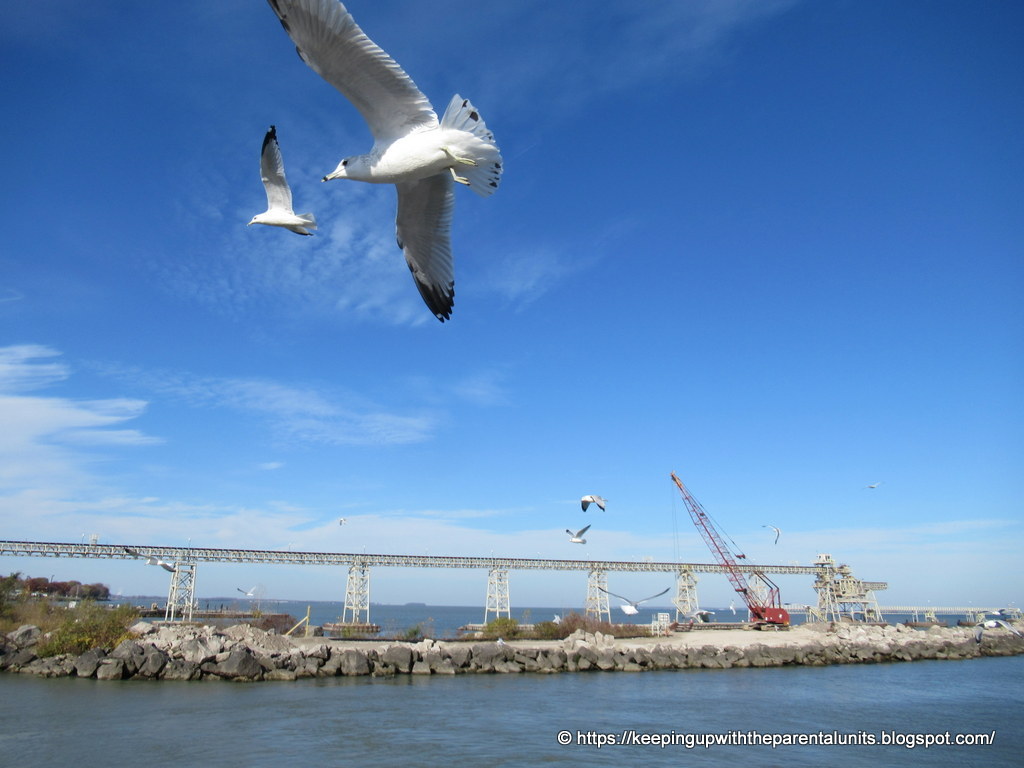
There is a lot of construction happening on Kellys Island, based on the trucks which were on the ferry with us. In case the ferry sank, my plan was to build a raft out of all this lumber.

The great lakes were gouged out of bedrock by glaciers during the ice ages. In a few places offshore in Lake Erie, the limestone bedrock was harder than the rest. The glaciers scraped over these areas leaving behind what are now islands, one of which is Kellys. Another is Pelee Island, 8 miles further north, which is in Canada. 
Verizon thought Kellys was also in Canada. 
I mentioned gouging by the glaciers. These were gouges in the rock in Glacier Grooves Natural Natural Landmark. Due to their large size and ease of accessibility, these are the most famous glacial grooves in the world.
Tons and tons of limestone were quarried on Kellys Island. These are some remains of that industry.
And one of the old quarries
Random views on Kellys
A summary
Marblehead lighthouse back on the mainland 

Monday, November 2, 2020

Cuyahoga Valley National Park - Part III - and Graupel

I learned a new word yesterday - Graupel.  It is defined as soft hail or snow pellets. Fortunately, the graupel didn’t start until late in the day, but together with scary high gusts of wind, it made for an interesting drive from Cuyahoga Valley National Park to East Harbor State Park on the shore of Lake Erie.

Finishing up Cuyahoga Valley National Park -  

Because of Covid, there are signs instructing people to “Hike Clockwise” at every loop trail. This is to reduce the number of people you pass while hiking.

Now I don’t know if people don’t know how to tell time, or maybe they were just confused because of the time change, but on the Brandywine Gorge Trail on Sunday, there were an awful lot of people going counterclockwise on the trail. 

This was a weird sign: 

Signal when passing? On a hiking trail? Were we supposed to send up a flare?

Brandywine Gorge Trail


Other stuff to see in the park:  

Ritchie Ledges:


The Tinkers Gorge area

Tinkers Creek Gorge Scenic Overlook

Bridal Veil Falls

Great Falls of Tinkers Creek at Viaduct Park


Graupel west of Cleveland


Saturday, October 31, 2020

Cuyahoga Valley National Park - Part II - The Ohio & Erie Canal Towpath Trail

The Ohio & Erie Canal Towpath Trail is 101 miles long, 19 of which are in Cuyahoga Valley National Park. We biked an extremely scenic section from the Boston Store to the Frazee House, 15½ miles round trip. 

Highlights were the old locks, the Northfield High Level Bridge, the Station Road Bridge, fall foliage, the Cuyahoga river, and Beaver Marsh. 

We would have done a one-way ride, but unfortunately, Bike Aboard, which lets you bike as far as you want on the towpath and take the train back, is not in service until it recovers from Covid.

Old lock
 Interior of a lock
Cuyahoga River
The sun actually came out for a few minutes
Station Road Bridge
Old Brecksville Station
Northfield High Level Bridge

One of the many bridges on the towpath

Some of the locals
  

Former Cleveland-Akron Bag Company Building 

Beaver in the Beaver Marsh. Full disclosure - we didn't bike this part of the towpath, but parked at the nearest trail head and walked over. Didn't see the any of the river otters 😧


Thursday, October 29, 2020

Top 10 Little Known Facts about Cuyahoga Valley National Park

1. It’s in Ohio, between Cleveland and Akron

2. Cuyahoga means “Crooked River” in the language of the Native Americans who used to live here

3. The Cuyahoga River was one of those infamous rivers that were so polluted by the dumping of industrial chemicals and sewage that they frequently caught fire 

4. The Cuyahoga River fire of 1969, also called the Lake Erie Fire, was written up in Time Magazine, had a song written about it, Randy Newman's "Burn On", and became a catalyst for the creation of the Environmental Protection Agency (1970) and the federal Clean Water Act (1972).  

5. By 1989, the Cuyahoga River was not quite pristine, but it was fireproof, at least according to the New York Times  

6. Cuyahoga Valley was designated as a National Recreation Area in 1974, and became a national park in 2000 

7. The river is now much healthier, as indicated by the fish and wildlife. Researchers use electrofishing to determine the numbers and kinds of fish in the river. Not to worry, when performed correctly, electrofishing results in no permanent harm to fish

8. Cuyahoga Valley National Park is no Yellowstone, but we are very much enjoying our visit

9. It does not always rain in the park, just when we are here. Thank you, Hurricane Zêta!  What’s with Z following E anyway? It’s all Greek to me. 

10. The Little Tykes Headquarters is a few miles from the Park. We passed it several times driving around the area. Sadly, they are not giving tours.


Blue Hen Falls 


I trade my hiking poles for an umbrella
Brandywine Falls